Showing posts with label basics. Show all posts

Saturday, 22 June 2019

Bipolar Junction Transistor As a Switch

Switching:


The Bipolar junction transistors can also be used for switching in a circuit. It means that we can use BJT as for current controlling switch. The current in the base will decide whether the current will flow from emitter to collector or not, that’s how it can be used as switch. BJT in circuit used for switching the high voltage or high power circuit with the very low power control variable. We will try to figure it out with the help of example.

Example of BJT as Switch:

As shown in figure below simple lamp circuit with a battery. As switch is open then lamp is off as in fig (1), while when switch is closed, the circuit is closed and lamp is glowing in fig (2).
Fig (1)

Fig (2)


Now when we used bipolar junction transistor in place of switch in above circuit and connect a 1 K resistor with base to provide some current for the base. NPN type of Bipolar junction transistor is being used in this circuit. PNP could also be used, it is just difference of polarity in connections. Keep in mind that the direction of flow of current should be opposite to the direction of arrow on emitter of BJT. The direction of current flow is shown by red arrows in fig (3).
Fig (3)


The BJT do switching in between two state regions; cut off region and saturation region. When there will be no resistor connected with base or if there is open circuit at base of BJT, then the flow of current from emitter to collector will not occur and transistor would be in its “cut off” state. And thus lamp will not glow.

While when there will be resistance connected with the base, some current will flow through base (where we have studied before base current is controlling current). When there will be current through base then current will pass through collector and lamp will glow up and transistor would be in "saturated" state.

So we have seen that we can do switching of high level with the very small amount of current in base. That’s a big advantage of having a BJTs.


Applications:

Due to this switching property of BJT, it has many application in industry and smart production.
1. In a thermocouple circuit, we can use BJT as switch while taking heat as a source for base current. So that with heat on switch on.
2. In automatic door, with the presence of a person near the door, will initiate the base and switch will open.
Like these it has many application in this era.

Thursday, 4 January 2018

What is Charge, current, voltage? Definition explanation

Charge

Definition:

“Charge or Electrical charge is the property of, unit of a matter”

Explanation:

Charge does not physically exist; this is only a theoretical word. Yes, we use the word charge physically in many topics, just to describe the topic by taking a simple or basic thing (charge). Charge tells that how the matter will react with the other matter or in a magnetic field or in a electric field.
A matter is named as charge, only when there is a difference in number of electrons and number of protons in atom of that matter. If there are more electrons than proton in atom then it is negative charge and if there are more protons than electrons then it is positive charge. Hence this is two types of charge negative and positive charge.

Unit:-

The unit of charge is Coulomb and represented by q. 

Current

Definition:-

“Current is the rate of flow of electric charges.”

Explanation:-

Current is the flow of electric charges which is free electrons. Current flows in a circuit when there is pressure or some force applied to the charges in a circuit. Current flows from negative end to towards positive end. Rate of flow means, how much charges will flow in some fix time. There are two types of current. AC and DC.
AC means alternating current. The current which changes its direction of flow after half interval is known as alternating current.
DC means direct current. The current which flow in only one direction is known as DC current.
Each type of current has its own application.

Unit:-

Unit of current is A Ampere.
“When one coulomb charge will flow in one second through some point, then current will be one ampere.”

 Voltage

Definition:-

“Voltage is a force or pressure which causes the charges to flow through circuit.”

Explanation:

As we discuss in explanation section of current that , current flows through the circuit when some force or pressure applied to the charges in circuit. That force and pressure is Voltage. It is also known as potential difference. In some words, Voltage is the power of current. Means with how much power the current is flowing. The more the voltages the more the rate of flow of current in a circuit.

Unit:


Unit of voltage is V volt.

Friday, 1 December 2017

Waves and types of waves

Definition:-

"Wave is the transfer of energy from one place to another place without the transfer of matter or body."

Explanation:-

Wave only transfer energy or disturbance from one place to another place with transfer of matter, they travels through some medium.
The above shown diagram is of wave. As seen that there also some parts of  waves. Crest and Trough.
The highest point of wave is known as crest and lowest part is known as tough, while rest position is the middle position.

Examples:-

1.When you throw the stone in the lake, then waves starts to travel arround the hit point of stone on water. these waves carries some energy, when you will put your finger in these waves you will some force.
2.Wind(Air flowing) is a kind of waves they can move away papers like stuff means carry some energy.
3. You speak, your voice travels to the other in the form of waves, as they feel sound means your voice has energy.

Types of Waves:-

there are three basics types of waves:-

1.Mechanical Waves act as the propagation of a disturbance through a material medium due to the repeated periodic motion of the particles of the medium about their mean positions, the disturbance being handed over from one particle to the next.

2.Electromagnetic Waves
 are the disturbance, which does not require any material medium for its propagation and can travel even through vacuum. They are caused due to varying electric and magnetic fields.

3.Matter Waves
 are the waves produced in electrons and particles

Thursday, 30 November 2017

Work

Definition:-

"Work is the product of force and the distance covered by a body due to force applied on it"


Explanation:-

In physics work is done on a body, when we apply some force on it and it covers some distance in the direction of force.
Work is not done until body is not covering some distance whether force is applied on it or not, body has to cover some distance in order to get work done. or work will not be done until force will not be apply on it whether it is covering some distance or not. so both things are necessary.

Example:-

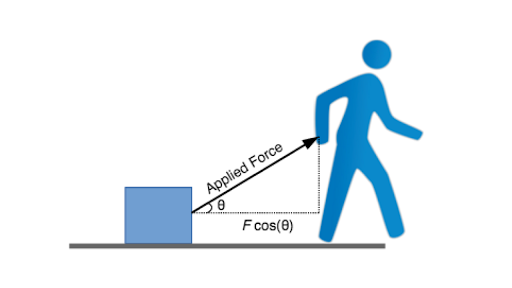
1.When you try to push the box by applying force on it and box start to move in direction of force, then your are doing work.
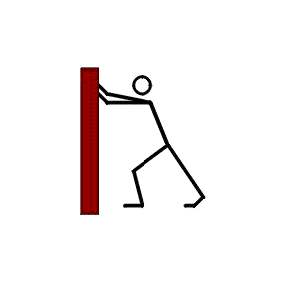
2.When you try to push the wall then you apply force but wall doesn't move, so you are not working (According to physics).

Unit:-

The Sl unit of work is joule J

Formula:-

Work also have an formula to calculate it mathematically,

W=F.d.cosθ

As define work is the product of force and distance and the angle between them. 


Conditions:-


1.This cos shows that when force applied and distance covered is in same direction then angle will be 0, where cos(0)=1, hence work will be maximum.
2. When force applied and distance cover will be perpendicular to each other than angle will be 90 and cos(90)=0, hence work will be 0.
3. When force applied and distance covered is in opposite direction  then work will be negative as, angle will be 180 and cos(180)=  -1.


AC Generator

Definition:-

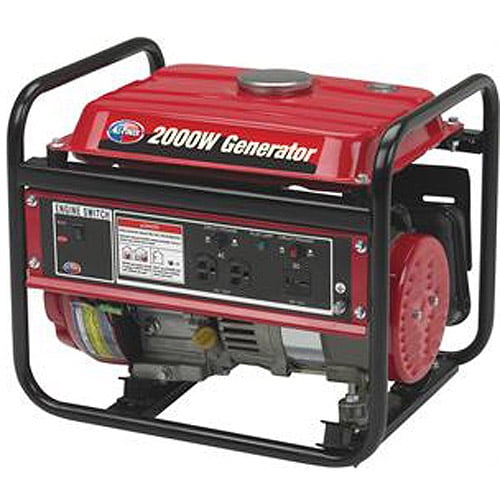
"The machine which is used to convert mechanical energy into electrical energy(AC current) is known as AC Generator"

Explanation:-

The device which gives us AC current(Electrical energy) by taking mechanical energy from any source(could be us) is known as Ac generator. Its construction is similar to dc generator and its working is also same almost. 


The above shown diagram is of AC generator. our need is to get the current which changes its direction after every half cycle, so to get this we need to get the current from one slip ring for one half and for other slip ring for the second half. Slip rings are connected at different ends of closed circuit. where load is connected. So that load will get Ac current.

Construction:-

It consists of following parts:-
1.Magnet
2.Slip Rings or Commutator
3.Conducting Coil or Armature
4.Carbon brushes
5. Load  

Working:-

According to the Faraday's Law of electromagnetic induction, whenever a conducting coil is move or rotates across magnetic field emf produces in it and due to this, current starts to flow through it. So in this generator when coil will move by some mechanical force across magnetic field of magnet, then there will produce an EMF and because of this, current will start to flow through it(if coil path is closed or connected to other circuit). Direction of current will be according to Fleming's right hand rule. 
As shown in this diagram, For first half rotation of coil the current will go to the load form one slip ring and for 2nd half rotation of coil the current will go from the other slip rings to the load so it is giving ac current to the load as it is changing its direction after every half cycle.


Wednesday, 29 November 2017

Generator(DC)

Definition:-

"The device which converts mechanical energy into electrical energy is known as Generator."


Explanation:-

Generator use to produce electrical energy from mechanical energy for our purpose.
Above shown diagram is of DC generator, its construction is same as Electric motor(DC), the difference is that from where we give input in input, from there we get output from generator. the mechanical energy could of any type. for example moving pivot with your hand and by some other source.

Construction:-

It consists of:-

1.Magnet
2.Conducting Coil loop
3.Commutator
4.Carbon brushes
5.Battery

Working:-

According to Faraday's law, whenever a conducting coil will move across magnetic field then there will produce an EMF, and due to this, current will start to flow through coil (if path is closed). the direction of current will be according to Fleming's Right hand rule(Described below). Then this current will go through commutator and through carbon brushes it will go through battery and will charge. That its simple working!


Faraday's Law of electromagnetic induction:-

This law state's that" whenever a conducting coil is move across the magnetic field of magnet, then EMF will produce in coil and current will start to flow through it" Current direction would be according to Fleming right hand rule.


Fleming's Right hand rule:-

According to this law "Straighten your thumb, fore finger and middle finger so that they become perpendicular to each other(right angle to each other) and then your thumb will represent the coil, your fore finger will represent the magnetic field and your middle finger will represent the direction of current flow."


Tuesday, 28 November 2017

Electrical Motor(DC)

Definition:

"Electric motor is a device that converts electrical energy to mechanical energy"
The device which converts electrical energy into other form of energy which is mechanical energy so that we can take benefit from it.


Types of Motor:

There are two basic types of electric motor:-
1.DC motor
2.AC motor


DC motor Explanation:

The motor which converts DC power to the mechanical energy or power is known as dc motor.
Above diagram is of dc motor. It consists of a magnet, armature or conducting loops, carbon brushes, commutator, dc source or battery.

Working:-

When we connect the battery with the carbon brushes than through commutator they cause the current to flow through loops, as on the other hand there is also magnetic field from north to south so as we have studied Fleming's left hand rule(will explain below), the loops will move upward from one side and will move downward from other side. When this current carrying conductor(conducting loops) will change position at 90 degree than again according to the Fleming's rule this loop will move as it is going. So that how it works. other end of loop would be connected with the object to whom we want to provide mechanical energy. 

Fleming's Left hand rule:-

This rule states that" hold your left hand and tied your 1st finger, 2nd finger and thumb in such a way that they each other become perpendicular(Right angle) to each other. now if first finger is the direction of magnetic field and 2nd finger represent the current flowing through coil, then thumb will represent the force acting on it." 

Saturday, 25 November 2017

Linked list

Linked list


Definition:

a linked list is a linear collection of data elements, in which linear order is not given by their physical placement in memory. Each pointing to the next node by means of a pointer. It is a data structure consisting of a group of nodes which together represent a sequence

Explanation:


A linked list is a linear data structure where each element is a separate object.
Each element of a list is comprising of two items - the data and a reference to the next node. The last node has a reference to null. The entry point into a linked list is called the head of the list. It should be noted that head is not a separate node, but the reference to the first node. If the list is empty then the head is a null reference.
A linked list is a dynamic data structure. The number of nodes in a list is not fixed and can grow and shrink on demand. Any application which has to deal with an unknown number of objects will need to use a linked list.

There are some figures below to explain Linked list.


Sunday, 6 August 2017

laws of motion. explanation

There are 3 laws of motion. It is described(invented) by Newton.
They're:

1.First law of motion (law of inertia)

"An object at rest stays at rest and an object in motion stays in motion with the same speed and in the same direction unless acted upon by an unbalanced force"


Explanation:

It means that a body in rest condition, will remain in rest until a force will act, whether is the Force by human, air or from anywhere.


 Example:

 A book will remain on table unless you will pick it or it is blow away by some wind. And body will remain in motion unless some force will stop it. I.e. A car will never stop until you break it.

2. Second law of motion

" Acceleration of an object is dependent upon two variables - the net force acting upon the object and the mass of the object."


Explanation:

It means that if a body has change in its velocity(speed) or position, then its depend upon the total force acting upon him and the mass of the body. It is also known as law of inertia. Having low mass will demand less force for change in its speed.

Example:

If you will apply same force on car and then truck. Car will have more acceleration than truck because car have less mass with respect to the truck.

Formula:

acceleration = Force/mass (a=F/m)

                                        F= a.m


Third law of motion:-

"For every action, there is an equal and opposite reaction."

Explanation:-

Its means that if there will be action from some body to other body, there is always a re-action from other body equal in force but opposite in direction.

Example:-

If you throw the tennis ball to the wall then ball will return back to you with same speed. You throw the ball it is an action the ball returns it is an reaction and in opposite direction.