Showing posts with label Science. Show all posts

Saturday, 9 December 2017

Self Induction, definition explanation formula unit

Self Inductance:-

"Self inductance is the property of coil to oppose change in current flowing through it"

Explanation:-


Consider there is a coil wire and current is flowing through it, whenever the current will change flowing through it, then there will induced emf which is known as self induced emf. And its direction will be opposite to the the current flowing through it. If current is increasing then self induced emf will try to decrease or flow in direction opposite to the current. But if current through the coil is decreasing then the induced emf will try to increase this current or will go in same direction as current is flowing.
In other simple words, Self induce emf will try to oppose in change in current.
This phenomena is known as Self induction.

Formula:-

The formula for self induction could be derive from the formula of induced emf formula.
Where L is the self induction, E is the induced emf and di/dt is the rate of changing current.

From this it is clear that self induction will increase when induced emf will increase and will decrease when rate of changing current will increase.

Unit:- 

Unit of self inductance is Henry(H).
"There will be 1 Henry of self inductance when induced voltage will be one and current will change 1 ampere in one second."


Wednesday, 6 December 2017

Power, its definition, explanation, formula, unit

Definition:-

"Power is define as rate of doing work or Work done per unit time."


Explanation:-

Power is the doing some work, taking less time. Power depends upon doing work and time taken to complete the work. A person have more power will do more work but take less time and person have less power will do less work but will take more time. So this is the concept of power. Work does not depend upon time while power depends upon. so this is the only difference between them.

Formula:-

The formula for power is work done per unit time.

Power = Work / time

as work is equal to 

work = F.d

so power would have,

Power = Force.displacement / time
P = F.d / t

Unit:-

Unit of power Watt  is define as " If one joule of work is done in one second then power will be one watt"
P = F.d / t
Watt= Newton. meter / seconds
Watt = joule / second.


Tuesday, 5 December 2017

Electric Fields lines and Forces

Electric Fields:-

"Electric Fields are the area or space or region around a body or particle which is charged, in which area it effects(attracts or repel) on other body or particle which is charged."

Explanation:-

Consider their is a charged particle A, it has Electric fields lines, because it is charged. When a unit positive charge(small charge) will come into its field lines then it will feel some force, which is the effect of Charged particle A. It will repel the unit charge (as positive and positive repel each other).
The unit positive charge will only feel this force when it will come into the region where there is Electric field lines of Particle A.
In above diagram unit charge 1 will feel force as it is in the field region of charged particle A, but 2 will not feel any force as it is out of field lines of charged particle A. 

Electric Forces:-

"The force which charged unit positive charge feel when it is in the electric field lines of charged particle (A)."

Explanation:-

As Charged particle have electric field region where it exerts some force on some other charged particle (when it comes in the electric field of that charge). There are two type of forces which is exert by the charged particle in its field region. Attractive force and Repulsive force. Positive charge exert repulsive force on other positive charged while it exert attractive force on negative charge. In general there is attractive forces in opposite charges and there is repulsive force in between like charges.  
In below pic A is positive charge and it is repelling other positive charge.

In below pic, A is positive charge which is attracting negative charge.


Friday, 1 December 2017

Waves and types of waves

Definition:-

"Wave is the transfer of energy from one place to another place without the transfer of matter or body."

Explanation:-

Wave only transfer energy or disturbance from one place to another place with transfer of matter, they travels through some medium.
The above shown diagram is of wave. As seen that there also some parts of  waves. Crest and Trough.
The highest point of wave is known as crest and lowest part is known as tough, while rest position is the middle position.

Examples:-

1.When you throw the stone in the lake, then waves starts to travel arround the hit point of stone on water. these waves carries some energy, when you will put your finger in these waves you will some force.
2.Wind(Air flowing) is a kind of waves they can move away papers like stuff means carry some energy.
3. You speak, your voice travels to the other in the form of waves, as they feel sound means your voice has energy.

Types of Waves:-

there are three basics types of waves:-

1.Mechanical Waves act as the propagation of a disturbance through a material medium due to the repeated periodic motion of the particles of the medium about their mean positions, the disturbance being handed over from one particle to the next.

2.Electromagnetic Waves
 are the disturbance, which does not require any material medium for its propagation and can travel even through vacuum. They are caused due to varying electric and magnetic fields.

3.Matter Waves
 are the waves produced in electrons and particles

Transformer, Definition, Explanation, working, construction, types

Definition:-

"Transformer is an electrical device that converts low voltage into high voltage or high voltage into low voltage."


Explanation:-

Transform the current or voltage, it is used to get high voltage when input is of low voltage and to get low voltage from high voltage.

Transform works on the principal of Mutual Induction, according to which "When alternating current flows through one winding of coil, due changing nature of ac current, there produce an emf across winding and magnetic flux around winding. When another winding of coil comes near the first winding, there is effect of magnetic flux of first winding on second winding and due to AC current as it changes continuously produces changing magnetic flux of first winding and due to this change there causes the EMF in second winding and hence current starts to flow through second winding, so this process is known as mutual Inductance". Transformer works on this principle. As there is no connection between two coils(we just bring the second nearer to the first), the current transfer will be very small as compared to first. So we use Core to link these two winding, because of this current loss is so small.

Construction:-

 It consists of following,
1.Primary coil
2.Secondary coil
3.Core
4.AC current source

Working:-

Whenever we supplies ac current to primary coil then due to changing nature of ac current there produces change in magnetic flux around this winding. And due to this changing current starts to flow through core and reached to the secondary winding and through this secondary winding goes to external circuit, When we need to change low voltage to high voltage then we have to increase the winding of secondary coil. This type of transformer is known as Step up Transformer. If we want to change the high voltage into low voltage, than we have to decrease the winding of secondary coil. This type of transformer is known as Step down Transformer.


Thursday, 30 November 2017

Work

Definition:-

"Work is the product of force and the distance covered by a body due to force applied on it"


Explanation:-

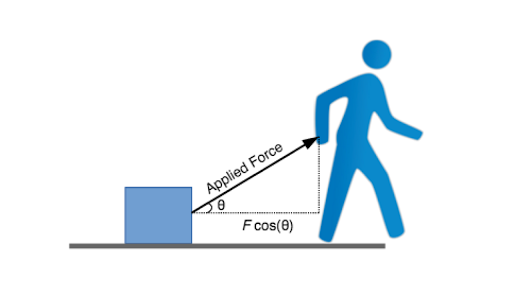
In physics work is done on a body, when we apply some force on it and it covers some distance in the direction of force.
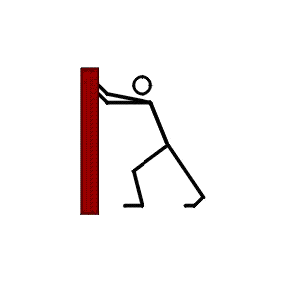
Work is not done until body is not covering some distance whether force is applied on it or not, body has to cover some distance in order to get work done. or work will not be done until force will not be apply on it whether it is covering some distance or not. so both things are necessary.

Example:-

1.When you try to push the box by applying force on it and box start to move in direction of force, then your are doing work.
2.When you try to push the wall then you apply force but wall doesn't move, so you are not working (According to physics).

Unit:-

The Sl unit of work is joule J

Formula:-

Work also have an formula to calculate it mathematically,

W=F.d.cosθ

As define work is the product of force and distance and the angle between them. 


Conditions:-


1.This cos shows that when force applied and distance covered is in same direction then angle will be 0, where cos(0)=1, hence work will be maximum.
2. When force applied and distance cover will be perpendicular to each other than angle will be 90 and cos(90)=0, hence work will be 0.
3. When force applied and distance covered is in opposite direction  then work will be negative as, angle will be 180 and cos(180)=  -1.


Tuesday, 28 November 2017

Electrical Motor(DC)

Definition:

"Electric motor is a device that converts electrical energy to mechanical energy"
The device which converts electrical energy into other form of energy which is mechanical energy so that we can take benefit from it.


Types of Motor:

There are two basic types of electric motor:-
1.DC motor
2.AC motor


DC motor Explanation:

The motor which converts DC power to the mechanical energy or power is known as dc motor.
Above diagram is of dc motor. It consists of a magnet, armature or conducting loops, carbon brushes, commutator, dc source or battery.

Working:-

When we connect the battery with the carbon brushes than through commutator they cause the current to flow through loops, as on the other hand there is also magnetic field from north to south so as we have studied Fleming's left hand rule(will explain below), the loops will move upward from one side and will move downward from other side. When this current carrying conductor(conducting loops) will change position at 90 degree than again according to the Fleming's rule this loop will move as it is going. So that how it works. other end of loop would be connected with the object to whom we want to provide mechanical energy. 

Fleming's Left hand rule:-

This rule states that" hold your left hand and tied your 1st finger, 2nd finger and thumb in such a way that they each other become perpendicular(Right angle) to each other. now if first finger is the direction of magnetic field and 2nd finger represent the current flowing through coil, then thumb will represent the force acting on it." 

Centripetal force

Definition:

"Centripetal force is a force, which keeps a body moving in a circular path and that force acting towards the center of that circular path."

Explanation:

A body never automatically or itself moves in a circular path it, there is always a reason or some force that causes it to move in a circular path and that force in general is known as a centripetal force. and that force is always directed towards  center. it means force is from the center of circular path that causes it to move in a circular path.

Example:

You tries to move a string in a circular path. one end of it is in your hand and other is tied with a stone. and consider that stone is a body. you provide force from your hand which is at the center of circular path in which stone(body) is moving.

Formula:


This equation shows that force depends on the mass of body and the velocity by which it is moving in path and the distance(r) between the center of circular path and body.


Sunday, 26 November 2017

What is motion? Types of motion

Motion:-

When a body does not change its position with time it is said that it is in rest but when it changes it is called that body is in motion.


Types of Motion:-

There are few basic types of motion:
1. Translational motion
2. Rotational motion
3. Random motion
4. Circular motion

Translational:-

A body covering some distance while moving whether it is on straight line or curved line, but distance covering is necessary. it is known as translational motion.
i.e. You driving a car towards your destination the road sometimes will not be straight turns will come but you will cover distance.


Rotational:-

A body moving on its axis and its all parts have different directions. no matter in which direction it moves but move on its axis is known as rotational motion.
i.e. A beblayde moving on its axis, a fan blades moving.

Random Motion:

When a body moves randomly, it is known as random motion.
Random motion means when body doesn't follow a specific path just a zig zag type path to move then this movement is known as random motion.
i.e. Fly, Mosquitoes etc,  flying around you randomly is an example of random motion.

Circular Motion:

When a body moves in a circular path, it is known as circular motion.
it is simple type of motion when body moves in a closed circular path it is known as circular motion.
i.e. a racing car moving on a circular racing track.


Wednesday, 2 August 2017

What is Science?

First of all the definition of Science should be understand, then break down of every line will be good.

Definition:

"knowledge or a system of knowledge covering general truths or the operation of general laws especially as obtained and tested through scientific method."

Now explanation of it:

Means, science is a knowledge base on true things or logic. It also have some general laws which comes from experiments done by scientist. And these laws satisfies in every related problem.