Showing posts with label detail. Show all posts

Friday, 21 June 2019

Bi Polar Junction Transistor (BJT): Introduction, Construction and Working


Introduction:

BJT stands for Bipolar Junction transistor which means two polar junctions. The reason it is called Bipolar is that it uses both electrons and holes for carrying charge or to flow the current. While FET is known as a unipolar transistor.

Construction:

As we have discussed diode before, and how it is formed by the junction of two regions, P doped region, and n doped region. The BJT is formed by the combination of two back to back diodes. The Bipolar junction transistor or BJT has two junctions of the semiconductor. In one of the two types (PNP), a thin n-region is shared by two p-regions. And in another type (NPN), a thin p-region is shared by two n-regions, the figure below explains this.


          Fig (a)


                                                                                 Fig (b)
                                   

This complete structure of BJT has three terminals and has three layers. Each terminal for each layer. And the names of these layers are Emitter, Base, and collector shown in above figure. For NPN the arrow is going away from the Emitter terminal and for PNP the arrow is towards the emitter terminal. The reason is explained later.

 Functions of BJT:

BJT can be used for three purposes,

  • Current controlling
  • switching
  • Amplification

Controlling Current:

BJTs are mostly used for controlling the amount of current flows from emitter to collector or collector to base. These are two cases for two different types of BJT (which are PNP and NPN). In PNP the current goes from Collector to emitter with the combination or addition of base current, see fig (a). While in NPN the current goes from Emitter to collector with separation or removal of base current see fig (b). In all this, the current which goes from emitter to collector or collector to emitter is the controlling current and the current which goes or comes from the base is controlled current. Now all this statement means that, the amount of current which have to go from emitter to collector in NPN transistor is decided by or controlled by the current flows towards the base as shown in the below picture.

           Fig(c)


                                                                                    Fig(d)


Equations of current:

This thing also produce the equation of current,


IE = IB + IC

Where IE is the Emitter current, IB is the base current and, IC is collector current.


IB = IE - IC

IC = IE - IB

Saturday, 15 June 2019

Transistor: Introduction, importance and history


Introduction:


The name “Transistor” has come from the two words “Transfer” and “Resistance”. Which then were combined into “Trans-resistance” and after that it was contracted to name as “Transistor”. From its origin words “transfer of resistance”, its process comes. Which is that the current passes from the low resistance portion to the high resistance portion for amplification.


Definition:  


“Transistor is a semiconductor device which is used to do the switching and amplifying of electronic signals.”

Means if you want to do switching in electric circuit like, to stop the flow of current at a point at particular condition then transistor is the best you got. Or if you want to amplify your input signal like if you want to increase the loudness of input voice then transistor can do this. These are the main uses of Transistor.


 History:


Before Transistor there was Vacuum tube which was the main or important component of electronic devices. But it was big in size have low efficiency, more heat up, high power consumption, required high voltages and current, and have complexity in circuits. Then there were ideas of Field effect transistor started to come in 1905. And then in 1947 John Bardeen and Walter Brattain and William Shockley (Group leader) invented the first complete transistor named as “point contact transistor”.  And then the first commercially available transistor came in 1960s.


Importance of Transistor:


Honestly! I will say in electric area the most useful thing we have now a days is transistor. Transistor is the building block of all the electric devices. We are getting now a days more smaller devices is just because of transistors as they have very small size. They are so small that we rarely found an individual transistor. They are found in integrated circuits in large numbers. An IC normally contain 20 to 60 transistors. The latest microprocessor contain almost 3 billion transistors and you can imagine the size of microprocessor. They are in our smart phones, smart watches, and radios and in every small smart device. The reason for their large use is their less cost and their requirements of low currents and voltages for operating.


Types of Transistor:

There two main types of Transistor,
  1. BJT Transistor (Bi Polar Junction)
  2. FETs Transistor(Field Effect Transistor)

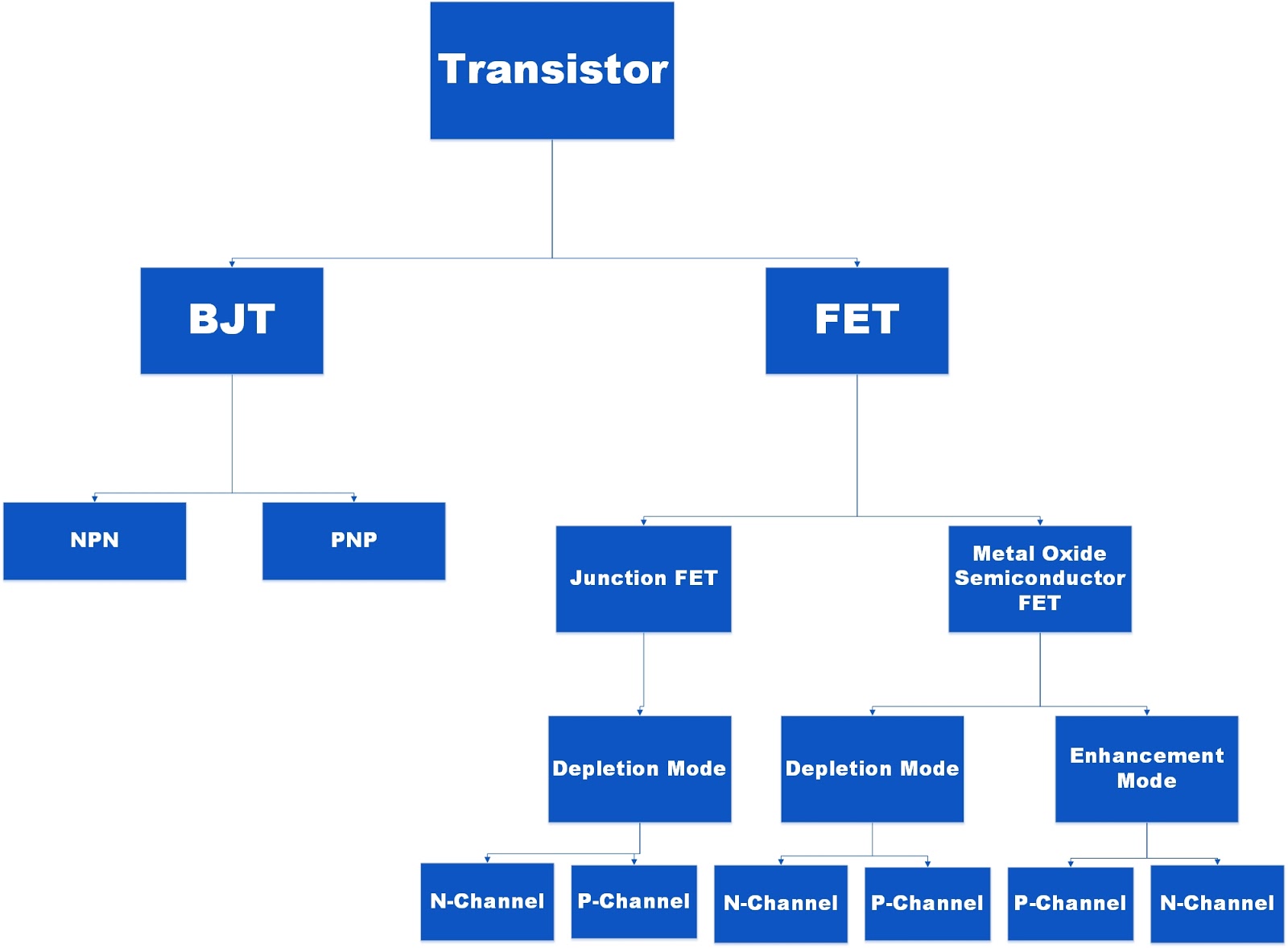
BJT transistor are further classified to:
  1. n-p-n
  2. p-n-p

While FETs have also further classification.
The transistor tree below show classification of these Transistors.


Thursday, 4 January 2018

What is Charge, current, voltage? Definition explanation

Charge

Definition:

“Charge or Electrical charge is the property of, unit of a matter”

Explanation:

Charge does not physically exist; this is only a theoretical word. Yes, we use the word charge physically in many topics, just to describe the topic by taking a simple or basic thing (charge). Charge tells that how the matter will react with the other matter or in a magnetic field or in a electric field.
A matter is named as charge, only when there is a difference in number of electrons and number of protons in atom of that matter. If there are more electrons than proton in atom then it is negative charge and if there are more protons than electrons then it is positive charge. Hence this is two types of charge negative and positive charge.

Unit:-

The unit of charge is Coulomb and represented by q. 

Current

Definition:-

“Current is the rate of flow of electric charges.”

Explanation:-

Current is the flow of electric charges which is free electrons. Current flows in a circuit when there is pressure or some force applied to the charges in a circuit. Current flows from negative end to towards positive end. Rate of flow means, how much charges will flow in some fix time. There are two types of current. AC and DC.
AC means alternating current. The current which changes its direction of flow after half interval is known as alternating current.
DC means direct current. The current which flow in only one direction is known as DC current.
Each type of current has its own application.

Unit:-

Unit of current is A Ampere.
“When one coulomb charge will flow in one second through some point, then current will be one ampere.”

 Voltage

Definition:-

“Voltage is a force or pressure which causes the charges to flow through circuit.”

Explanation:

As we discuss in explanation section of current that , current flows through the circuit when some force or pressure applied to the charges in circuit. That force and pressure is Voltage. It is also known as potential difference. In some words, Voltage is the power of current. Means with how much power the current is flowing. The more the voltages the more the rate of flow of current in a circuit.

Unit:


Unit of voltage is V volt.

Wednesday, 6 December 2017

Capacitor, definition, formula, explanation, Capacitance

Definition:-

"Capacitor is an electrical device which is used to store energy or charges between its plates."

Explanation:-

Capacitor is use to store charge so that we could use it later by discharging it. It stores electrical charge between its parallel plates which are known as conducting plates of capacitor. There is no connection between these conducting parallel plates. They are separated by air or some dielectric. We use dielectric in capacitor to increase its efficiency. By using dielectric we could store more charge between its plates.
Capacitor doesn't allow dc current to flow through it because DC current flows only in one direction. so, it after charging from dc current it allows to flow through it as there is nothing in the circuit.
While it allows AC current to flow through it because ac current changes its direction after half interval, so capacitor charges at first half and discharges at 2nd half.

Capacitance:-

Capacitance is the ability of a capacitor to store charge. Capacitance tells us that how much charge we can store between the plates of capacitor. Capacitance is the unit of capacitor in one way. While capacitance has unit Farad. Farad is define as,
"When there will be 1 volts across capacitor then it will charge one coulomb, its mean capacitor have one farad capacitance."

Formula:-

By seeing definition of farad we could write formula for the capacitance of capacitor,
Q = CV
C = Q/V

Power, its definition, explanation, formula, unit

Definition:-

"Power is define as rate of doing work or Work done per unit time."


Explanation:-

Power is the doing some work, taking less time. Power depends upon doing work and time taken to complete the work. A person have more power will do more work but take less time and person have less power will do less work but will take more time. So this is the concept of power. Work does not depend upon time while power depends upon. so this is the only difference between them.

Formula:-

The formula for power is work done per unit time.

Power = Work / time

as work is equal to 

work = F.d

so power would have,

Power = Force.displacement / time
P = F.d / t

Unit:-

Unit of power Watt  is define as " If one joule of work is done in one second then power will be one watt"
P = F.d / t
Watt= Newton. meter / seconds
Watt = joule / second.


Friday, 1 December 2017

Waves and types of waves

Definition:-

"Wave is the transfer of energy from one place to another place without the transfer of matter or body."

Explanation:-

Wave only transfer energy or disturbance from one place to another place with transfer of matter, they travels through some medium.
The above shown diagram is of wave. As seen that there also some parts of  waves. Crest and Trough.
The highest point of wave is known as crest and lowest part is known as tough, while rest position is the middle position.

Examples:-

1.When you throw the stone in the lake, then waves starts to travel arround the hit point of stone on water. these waves carries some energy, when you will put your finger in these waves you will some force.
2.Wind(Air flowing) is a kind of waves they can move away papers like stuff means carry some energy.
3. You speak, your voice travels to the other in the form of waves, as they feel sound means your voice has energy.

Types of Waves:-

there are three basics types of waves:-

1.Mechanical Waves act as the propagation of a disturbance through a material medium due to the repeated periodic motion of the particles of the medium about their mean positions, the disturbance being handed over from one particle to the next.

2.Electromagnetic Waves
 are the disturbance, which does not require any material medium for its propagation and can travel even through vacuum. They are caused due to varying electric and magnetic fields.

3.Matter Waves
 are the waves produced in electrons and particles

Thursday, 30 November 2017

AC Generator

Definition:-

"The machine which is used to convert mechanical energy into electrical energy(AC current) is known as AC Generator"

Explanation:-

The device which gives us AC current(Electrical energy) by taking mechanical energy from any source(could be us) is known as Ac generator. Its construction is similar to dc generator and its working is also same almost. 


The above shown diagram is of AC generator. our need is to get the current which changes its direction after every half cycle, so to get this we need to get the current from one slip ring for one half and for other slip ring for the second half. Slip rings are connected at different ends of closed circuit. where load is connected. So that load will get Ac current.

Construction:-

It consists of following parts:-
1.Magnet
2.Slip Rings or Commutator
3.Conducting Coil or Armature
4.Carbon brushes
5. Load  

Working:-

According to the Faraday's Law of electromagnetic induction, whenever a conducting coil is move or rotates across magnetic field emf produces in it and due to this, current starts to flow through it. So in this generator when coil will move by some mechanical force across magnetic field of magnet, then there will produce an EMF and because of this, current will start to flow through it(if coil path is closed or connected to other circuit). Direction of current will be according to Fleming's right hand rule. 
As shown in this diagram, For first half rotation of coil the current will go to the load form one slip ring and for 2nd half rotation of coil the current will go from the other slip rings to the load so it is giving ac current to the load as it is changing its direction after every half cycle.


Saturday, 25 November 2017

Linked list

Linked list


Definition:

linked list is a linear collection of data elements, in which linear order is not given by their physical placement in memory. Each pointing to the next node by means of a pointer. It is a data structure consisting of a group of nodes which together represent a sequence

Explanation:


A linked list is a linear data structure where each element is a separate object.
Each element of a list is comprising of two items - the data and a reference to the next node. The last node has a reference to null. The entry point into a linked list is called the head of the list. It should be noted that head is not a separate node, but the reference to the first node. If the list is empty then the head is a null reference.
A linked list is a dynamic data structure. The number of nodes in a list is not fixed and can grow and shrink on demand. Any application which has to deal with an unknown number of objects will need to use a linked list.

There are some figures below to explain Linked list.


Thursday, 3 August 2017

What is Physics?

First of all you have to know about  definition of physics and then break down of it.

Definition:

"The branch of science concerned with the nature and properties of matter and energy."

Physics is the branch of science which is concerned with matter and energy. It is the study of thier behaviour in different conditions and forms.
Through physics knowledge many laws has been introduced, because of it we can solve related problems easily.