Showing posts with label unit. Show all posts

Thursday, 4 January 2018

What is Charge, current, voltage? Definition explanation

Charge

Definition:

“Charge or Electrical charge is the property of, unit of a matter”

Explanation:

Charge does not physically exist; this is only a theoretical word. Yes, we use the word charge physically in many topics, just to describe the topic by taking a simple or basic thing (charge). Charge tells that how the matter will react with the other matter or in a magnetic field or in a electric field.
A matter is named as charge, only when there is a difference in number of electrons and number of protons in atom of that matter. If there are more electrons than proton in atom then it is negative charge and if there are more protons than electrons then it is positive charge. Hence this is two types of charge negative and positive charge.

Unit:-

The unit of charge is Coulomb and represented by q. 

Current

Definition:-

“Current is the rate of flow of electric charges.”

Explanation:-

Current is the flow of electric charges which is free electrons. Current flows in a circuit when there is pressure or some force applied to the charges in a circuit. Current flows from negative end to towards positive end. Rate of flow means, how much charges will flow in some fix time. There are two types of current. AC and DC.
AC means alternating current. The current which changes its direction of flow after half interval is known as alternating current.
DC means direct current. The current which flow in only one direction is known as DC current.
Each type of current has its own application.

Unit:-

Unit of current is A Ampere.
“When one coulomb charge will flow in one second through some point, then current will be one ampere.”

 Voltage

Definition:-

“Voltage is a force or pressure which causes the charges to flow through circuit.”

Explanation:

As we discuss in explanation section of current that , current flows through the circuit when some force or pressure applied to the charges in circuit. That force and pressure is Voltage. It is also known as potential difference. In some words, Voltage is the power of current. Means with how much power the current is flowing. The more the voltages the more the rate of flow of current in a circuit.

Unit:


Unit of voltage is V volt.

Saturday, 30 December 2017

Electric flux density, definition, explanation

Definition:

"Electric flux density is the electric flux passing through some unit area, and its direction is perpendicular to that unit area."

Explanation:

"Electric flux density", when we break down this sentence into "electric flux" and "density".
Then it is easy to understand that, the density of electric flux across some area. Consider there is a unit area shown below.


Electric flux is passing through this, in direction perpendicular to the unit area. The amount of electric flux passing through this unit area, in direction perpendicular to the unit area is called Electric flux density.


Formula:

When we write mathematically the electric flux density it is equal to the product of electric field E and permittivity of material.

                                                                           D=Ɛ.E
Unit:
The unit of electric flux density is coulombs per meter squared. 

Thursday, 7 December 2017

Inductor, Inductance, explanation, formula

Definition:-

"Inductor is an electronic device that is use to store energy in the form of magnetic field."


Explanation:-

Inductor store energy in magnetic field around it. Inductor is an coil of a conductor(wire). wire wounding on some rod or magnet. when a current passes through the conductor then there will be magnetic field around the wire. We wound the wire because by winding there would produce a strong magnetic field around this, we could increase the strength of  magnetic field around coil by taking efficient core like magnet and by increasing number of turns of coil and increasing cross sectional area of inductor. When current flows through the inductor there would produce magnetic field around it and in that magnetic field energy would be store (in the form electrons). It would be store until current is flowing through it. When current will stop it will release all the energy.
Inductor does not allow AC current to flow through it due its changing direction nature. While inductor resist to change in current so it becomes open in a circuit while AC current flows through the circuit. It allows DC current to flow through it. After charging completely it allows DC to flow through the circuit hence become short in circuit with zero resistance.

Inductance:-

Inductance is the property of a inductor which is that "whenever Flux is changed in it, it produces an EMF."
or in simple words
Inductance is the ability of an inductor to store energy in the form magnetic field.
Henry is the unit of Inductance.

Formula:

formula for inductance of inductor is,


Wednesday, 6 December 2017

Capacitor, definition, formula, explanation, Capacitance

Definition:-

"Capacitor is an electrical device which is used to store energy or charges between its plates."

Explanation:-

Capacitor is use to store charge so that we could use it later by discharging it. It stores electrical charge between its parallel plates which are known as conducting plates of capacitor. There is no connection between these conducting parallel plates. They are separated by air or some dielectric. We use dielectric in capacitor to increase its efficiency. By using dielectric we could store more charge between its plates.
Capacitor doesn't allow dc current to flow through it because DC current flows only in one direction. so, it after charging from dc current it allows to flow through it as there is nothing in the circuit.
While it allows AC current to flow through it because ac current changes its direction after half interval, so capacitor charges at first half and discharges at 2nd half.

Capacitance:-

Capacitance is the ability of a capacitor to store charge. Capacitance tells us that how much charge we can store between the plates of capacitor. Capacitance is the unit of capacitor in one way. While capacitance has unit Farad. Farad is define as,
"When there will be 1 volts across capacitor then it will charge one coulomb, its mean capacitor have one farad capacitance."

Formula:-

By seeing definition of farad we could write formula for the capacitance of capacitor,
Q = CV
C = Q/V

Power, its definition, explanation, formula, unit

Definition:-

"Power is define as rate of doing work or Work done per unit time."


Explanation:-

Power is the doing some work, taking less time. Power depends upon doing work and time taken to complete the work. A person have more power will do more work but take less time and person have less power will do less work but will take more time. So this is the concept of power. Work does not depend upon time while power depends upon. so this is the only difference between them.

Formula:-

The formula for power is work done per unit time.

Power = Work / time

as work is equal to 

work = F.d

so power would have,

Power = Force.displacement / time
P = F.d / t

Unit:-

Unit of power Watt  is define as " If one joule of work is done in one second then power will be one watt"
P = F.d / t
Watt= Newton. meter / seconds
Watt = joule / second.


Thursday, 30 November 2017

Work

Definition:-

"Work is the product of force and the distance covered by a body due to force applied on it"


Explanation:-

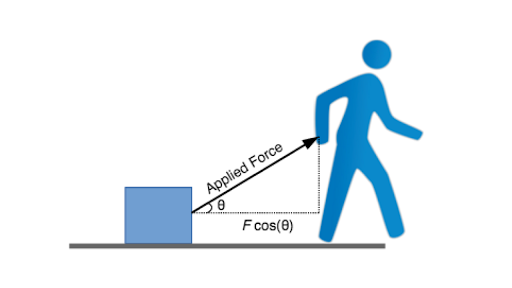
In physics work is done on a body, when we apply some force on it and it covers some distance in the direction of force.
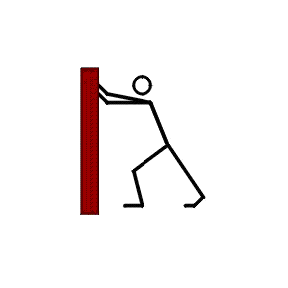
Work is not done until body is not covering some distance whether force is applied on it or not, body has to cover some distance in order to get work done. or work will not be done until force will not be apply on it whether it is covering some distance or not. so both things are necessary.

Example:-

1.When you try to push the box by applying force on it and box start to move in direction of force, then your are doing work.
2.When you try to push the wall then you apply force but wall doesn't move, so you are not working (According to physics).

Unit:-

The Sl unit of work is joule J

Formula:-

Work also have an formula to calculate it mathematically,

W=F.d.cosθ

As define work is the product of force and distance and the angle between them. 


Conditions:-


1.This cos shows that when force applied and distance covered is in same direction then angle will be 0, where cos(0)=1, hence work will be maximum.
2. When force applied and distance cover will be perpendicular to each other than angle will be 90 and cos(90)=0, hence work will be 0.
3. When force applied and distance covered is in opposite direction  then work will be negative as, angle will be 180 and cos(180)=  -1.


Sunday, 26 November 2017

What is Force?

Definition:-

"Force is a reason or something that causes the change in a motion or situation of a body."

Explanation:

Force is the reason which causes change, if you want to move something or you want to do some work you have to apply force.
A force is a vector quantity. a vector quantity is a quantity that has both magnitude and direction.


Unit:

Force is a quantity that is measured using the standard metric unit known as the Newton.  
1 Newton = 1 kg • m/s2


Formula:


According to the newton second law of motion, force is the product of mass and acceleration. Means force depends on mass and acceleration of body.It means that if a body has change in its velocity(speed) or position, then its depend upon the total force acting upon him and the mass of the body. It is also known as law of inertia. Having low mass will demand less force for change in its speed.

F=m.a