Showing posts with label physics. Show all posts

Thursday, 4 January 2018

What is Charge, current, voltage? Definition explanation

Charge

Definition:

“Charge or Electrical charge is the property of, unit of a matter”

Explanation:

Charge does not physically exist; this is only a theoretical word. Yes, we use the word charge physically in many topics, just to describe the topic by taking a simple or basic thing (charge). Charge tells that how the matter will react with the other matter or in a magnetic field or in a electric field.
A matter is named as charge, only when there is a difference in number of electrons and number of protons in atom of that matter. If there are more electrons than proton in atom then it is negative charge and if there are more protons than electrons then it is positive charge. Hence this is two types of charge negative and positive charge.

Unit:-

The unit of charge is Coulomb and represented by q. 

Current

Definition:-

“Current is the rate of flow of electric charges.”

Explanation:-

Current is the flow of electric charges which is free electrons. Current flows in a circuit when there is pressure or some force applied to the charges in a circuit. Current flows from negative end to towards positive end. Rate of flow means, how much charges will flow in some fix time. There are two types of current. AC and DC.
AC means alternating current. The current which changes its direction of flow after half interval is known as alternating current.
DC means direct current. The current which flow in only one direction is known as DC current.
Each type of current has its own application.

Unit:-

Unit of current is A Ampere.
“When one coulomb charge will flow in one second through some point, then current will be one ampere.”

 Voltage

Definition:-

“Voltage is a force or pressure which causes the charges to flow through circuit.”

Explanation:

As we discuss in explanation section of current that , current flows through the circuit when some force or pressure applied to the charges in circuit. That force and pressure is Voltage. It is also known as potential difference. In some words, Voltage is the power of current. Means with how much power the current is flowing. The more the voltages the more the rate of flow of current in a circuit.

Unit:


Unit of voltage is V volt.

Wednesday, 3 January 2018

Electric Potential: definition, explanation, example.

Definition:

"Electric potential is the amount of word done in moving a point test charge from its original position(reference position) to some specific point or position, while moving the charge in direction opposite to direction of field in which charge is present."


Explanation:-

The definition above seem to be difficult to understand the electric potential but I will explain it briefly.
Consider their is a positive point charge A, which have its own electric field around it. And there is another positive test charge B which has no electric field.


 When we will move the test charge B towards the electric field of point charge A then test charge B will move away from the point charge A. This is natural that charge always move from high potential to low potential.


low potential is the area where the charge feels less force while high potential is the area where the force is high.


So to move charge, against its natural movements. we have to provide electric potential or force or to do work. To move test charge B towards the charge A we have to apply some potential which is electric potential, to move the charge from low potential to high potential. So charge B will gain potential energy while moving towards high potential from low potential.

Electric potential is the basic studies of charges behavior with each other. So if you feel there is some type of confusion feel free to comment. The post will be update!

Saturday, 30 December 2017

Coulomb's law, definition explanation

Definition:-

"The magnitude of electrostatic force of attraction and the magnitude of electrostatic force of repulsion between two point charges is directly proportional to the product of magnitude of both charges and inversely proportional to the square of distance between them(both charges)."


Formula:-


mathematically we can write this in the form,
where F is the force,
q1 is the charge 1 and q2 is the charge 2,
and r is the distance between them.
this proportionality can be removed by placing proportionality constant k. in the formula, 

where the value of this constant depends upon the medium between the two point charges.
When there will be air then its value will be 9.0 x 10⁹ N • m/ C2.
And this value of k will change, with the change in medium between the two charges.


Wednesday, 27 December 2017

Lenz's law, definition, explanation

Definition:-

"The electric current induced in a circuit or somewhere, always tries to decrease the source which produces it or flow in opposite direction to decrease its effect."  

Lenz's law expand the law of electromagnetism which only tell about induced electric current.

Explanation:-

As we came to know through Lenz's law that the current induced, always tries to do opposite, for the source which is producing it, 


Example:-

lets take an example of a permanent magnet and a coil. 
When we bring the magnet north pole near to the coil there will be change in magnetic field across coil as we move magnet, thus because of changing magnetic field there will induce electric current in it. As we bought the north pole of magnet to the coil, so current induced in coil will start to flow in such a direction that it will make north pole of it towards the permanent magnet north pole, as everybody knows that, like poles of magnet repel each other, hence there, these two north pole will also follow the same rule. And When we will try to bring back the magnet then the current induced in the coil will flow in such a direction, that it will make south pole towards the permanent magnet north pole, where unlike poles attract each other, hence they will attract each other. 
So by doing this current induced in the coil is trying to oppose the source(permanent magnet). By pushing it back when we bring near it(creating north pole towards north pole of magnet) and by pushing it closer when we bring back the magnet(by creating south pole towards the magnet.)

Saturday, 9 December 2017

Self Induction, definition explanation formula unit

Self Inductance:-

"Self inductance is the property of coil to oppose change in current flowing through it"

Explanation:-


Consider there is a coil wire and current is flowing through it, whenever the current will change flowing through it, then there will induced emf which is known as self induced emf. And its direction will be opposite to the the current flowing through it. If current is increasing then self induced emf will try to decrease or flow in direction opposite to the current. But if current through the coil is decreasing then the induced emf will try to increase this current or will go in same direction as current is flowing.
In other simple words, Self induce emf will try to oppose in change in current.
This phenomena is known as Self induction.

Formula:-

The formula for self induction could be derive from the formula of induced emf formula.
Where L is the self induction, E is the induced emf and di/dt is the rate of changing current.

From this it is clear that self induction will increase when induced emf will increase and will decrease when rate of changing current will increase.

Unit:- 

Unit of self inductance is Henry(H).
"There will be 1 Henry of self inductance when induced voltage will be one and current will change 1 ampere in one second."


Thursday, 7 December 2017

Capacitive and Inductive Reactance and their explanation

Capacitive Reactance:-

"Capacitive reactance is the resistance offer by capacitor to the current."

Explanation:-

Whenever there is current flows through the capacitor there is the opposition offer by it to the current, which causes delay in its charging. And its this reactance depends upon the frequency of AC current flowing through it. the more the frequency the less its reactance will be and less the frequency the more the reactance will be. The formula for the capacitive reactance is below.


Inductive Reactance:-

"Inductive reactance is the resistance offer by inductor to the current flowing through it."

Explanation:-

When AC current flows through the inductor it offer some resistance to the current. it depends upon the frequency of current. The more the frequency the more the reactance and less the frequency less the reactance. This behaviour is of inductor when AC current flows through it.


Inductor, Inductance, explanation, formula

Definition:-

"Inductor is an electronic device that is use to store energy in the form of magnetic field."


Explanation:-

Inductor store energy in magnetic field around it. Inductor is an coil of a conductor(wire). wire wounding on some rod or magnet. when a current passes through the conductor then there will be magnetic field around the wire. We wound the wire because by winding there would produce a strong magnetic field around this, we could increase the strength of  magnetic field around coil by taking efficient core like magnet and by increasing number of turns of coil and increasing cross sectional area of inductor. When current flows through the inductor there would produce magnetic field around it and in that magnetic field energy would be store (in the form electrons). It would be store until current is flowing through it. When current will stop it will release all the energy.
Inductor does not allow AC current to flow through it due its changing direction nature. While inductor resist to change in current so it becomes open in a circuit while AC current flows through the circuit. It allows DC current to flow through it. After charging completely it allows DC to flow through the circuit hence become short in circuit with zero resistance.

Inductance:-

Inductance is the property of a inductor which is that "whenever Flux is changed in it, it produces an EMF."
or in simple words
Inductance is the ability of an inductor to store energy in the form magnetic field.
Henry is the unit of Inductance.

Formula:

formula for inductance of inductor is,


Wednesday, 6 December 2017

Capacitor, definition, formula, explanation, Capacitance

Definition:-

"Capacitor is an electrical device which is used to store energy or charges between its plates."

Explanation:-

Capacitor is use to store charge so that we could use it later by discharging it. It stores electrical charge between its parallel plates which are known as conducting plates of capacitor. There is no connection between these conducting parallel plates. They are separated by air or some dielectric. We use dielectric in capacitor to increase its efficiency. By using dielectric we could store more charge between its plates.
Capacitor doesn't allow dc current to flow through it because DC current flows only in one direction. so, it after charging from dc current it allows to flow through it as there is nothing in the circuit.
While it allows AC current to flow through it because ac current changes its direction after half interval, so capacitor charges at first half and discharges at 2nd half.

Capacitance:-

Capacitance is the ability of a capacitor to store charge. Capacitance tells us that how much charge we can store between the plates of capacitor. Capacitance is the unit of capacitor in one way. While capacitance has unit Farad. Farad is define as,
"When there will be 1 volts across capacitor then it will charge one coulomb, its mean capacitor have one farad capacitance."

Formula:-

By seeing definition of farad we could write formula for the capacitance of capacitor,
Q = CV
C = Q/V

Power, its definition, explanation, formula, unit

Definition:-

"Power is define as rate of doing work or Work done per unit time."


Explanation:-

Power is the doing some work, taking less time. Power depends upon doing work and time taken to complete the work. A person have more power will do more work but take less time and person have less power will do less work but will take more time. So this is the concept of power. Work does not depend upon time while power depends upon. so this is the only difference between them.

Formula:-

The formula for power is work done per unit time.

Power = Work / time

as work is equal to 

work = F.d

so power would have,

Power = Force.displacement / time
P = F.d / t

Unit:-

Unit of power Watt  is define as " If one joule of work is done in one second then power will be one watt"
P = F.d / t
Watt= Newton. meter / seconds
Watt = joule / second.


Tuesday, 5 December 2017

Why like charges repel each other and unlike charges attract each other?

Why like charges repel each other?

"Like charges repel each other because, it depends upon where the two charges have their electric field forces directed."

As positive charge have electric field lines going away from it and when two positive charge particles come near to each other there electric field lines tries to bend each other and their lines of forces are opposite in direction with respect to each other so both particles tries to send away to each other and hence in this way they repels each other.
Below diagram explain all the things which is described above.

Why unlike charges attract each other?

Like charges attract each other because their electric field lines are in the same direction in respective to each other, as we know Negative charge have electric field lines towards it(or coming to each other), and positive charge have away from it or going away from it. so when both comes near to each other, while negative charge tries to attract positive charge and positive charge tries to move towards negative each other.
Below picture explain all the phenomena describe above.


Saturday, 2 December 2017

Equations of Motion(and their derivation)

There are three equations of motion:-


Explanation:-


This equation is used to find the final velocity of a body or latest velocity of body or current velocity of body. This equation is known ass first equation of body.
Whenever a body starts to move it have some initial velocity and when after some interval of time t it have some change in velocity, after which its velocity becomes So above equation is for final velocity. Now see its derivation.
Change in velocity ∆v is equal to,

(2)

This is equation is used to find the distance covered by a body having initial velocity Vi and after time t.
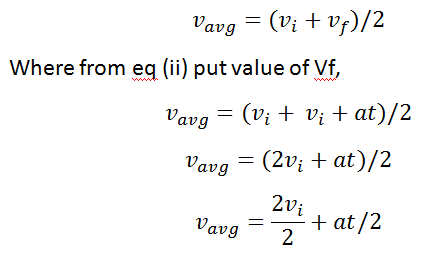
Consider a car moving with initial velocity Vi and final velocity Vf, then it would have average velocity will be,


(3)

In this equation there is distance , acceleration, final velocity and initial velocity are related.
We could find one, if we know other.
According to first equation of motion,


Friday, 1 December 2017

Waves and types of waves

Definition:-

"Wave is the transfer of energy from one place to another place without the transfer of matter or body."

Explanation:-

Wave only transfer energy or disturbance from one place to another place with transfer of matter, they travels through some medium.
The above shown diagram is of wave. As seen that there also some parts of  waves. Crest and Trough.
The highest point of wave is known as crest and lowest part is known as tough, while rest position is the middle position.

Examples:-

1.When you throw the stone in the lake, then waves starts to travel arround the hit point of stone on water. these waves carries some energy, when you will put your finger in these waves you will some force.
2.Wind(Air flowing) is a kind of waves they can move away papers like stuff means carry some energy.
3. You speak, your voice travels to the other in the form of waves, as they feel sound means your voice has energy.

Types of Waves:-

there are three basics types of waves:-

1.Mechanical Waves act as the propagation of a disturbance through a material medium due to the repeated periodic motion of the particles of the medium about their mean positions, the disturbance being handed over from one particle to the next.

2.Electromagnetic Waves
 are the disturbance, which does not require any material medium for its propagation and can travel even through vacuum. They are caused due to varying electric and magnetic fields.

3.Matter Waves
 are the waves produced in electrons and particles

Thursday, 30 November 2017

Work

Definition:-

"Work is the product of force and the distance covered by a body due to force applied on it"


Explanation:-

In physics work is done on a body, when we apply some force on it and it covers some distance in the direction of force.
Work is not done until body is not covering some distance whether force is applied on it or not, body has to cover some distance in order to get work done. or work will not be done until force will not be apply on it whether it is covering some distance or not. so both things are necessary.

Example:-

1.When you try to push the box by applying force on it and box start to move in direction of force, then your are doing work.
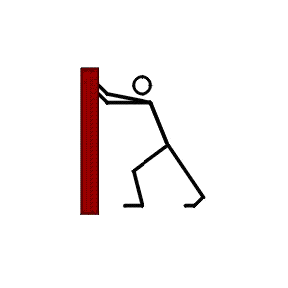
2.When you try to push the wall then you apply force but wall doesn't move, so you are not working (According to physics).

Unit:-

The Sl unit of work is joule J

Formula:-

Work also have an formula to calculate it mathematically,

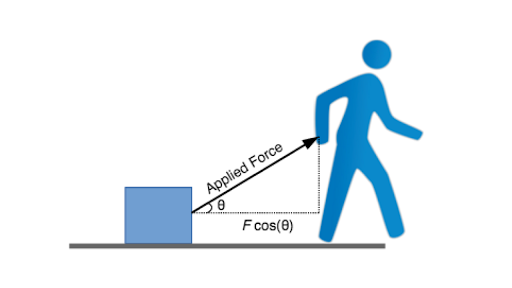
W=F.d.cosθ

As define work is the product of force and distance and the angle between them. 


Conditions:-


1.This cos shows that when force applied and distance covered is in same direction then angle will be 0, where cos(0)=1, hence work will be maximum.
2. When force applied and distance cover will be perpendicular to each other than angle will be 90 and cos(90)=0, hence work will be 0.
3. When force applied and distance covered is in opposite direction  then work will be negative as, angle will be 180 and cos(180)=  -1.


Wednesday, 29 November 2017

Generator(DC)

Definition:-

"The device which converts mechanical energy into electrical energy is known as Generator."


Explanation:-

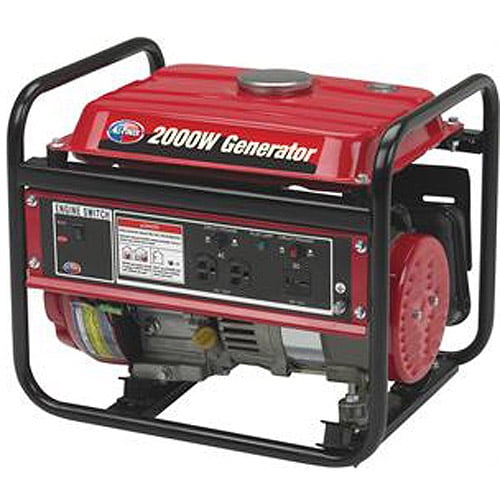
Generator use to produce electrical energy from mechanical energy for our purpose.
Above shown diagram is of DC generator, its construction is same as Electric motor(DC), the difference is that from where we give input in input, from there we get output from generator. the mechanical energy could of any type. for example moving pivot with your hand and by some other source.

Construction:-

It consists of:-

1.Magnet
2.Conducting Coil loop
3.Commutator
4.Carbon brushes
5.Battery

Working:-

According to Faraday's law, whenever a conducting coil will move across magnetic field then there will produce an EMF, and due to this, current will start to flow through coil (if path is closed). the direction of current will be according to Fleming's Right hand rule(Described below). Then this current will go through commutator and through carbon brushes it will go through battery and will charge. That its simple working!


Faraday's Law of electromagnetic induction:-

This law state's that" whenever a conducting coil is move across the magnetic field of magnet, then EMF will produce in coil and current will start to flow through it" Current direction would be according to Fleming right hand rule.


Fleming's Right hand rule:-

According to this law "Straighten your thumb, fore finger and middle finger so that they become perpendicular to each other(right angle to each other) and then your thumb will represent the coil, your fore finger will represent the magnetic field and your middle finger will represent the direction of current flow."


Tuesday, 28 November 2017

Electrical Motor(DC)

Definition:

"Electric motor is a device that converts electrical energy to mechanical energy"
The device which converts electrical energy into other form of energy which is mechanical energy so that we can take benefit from it.


Types of Motor:

There are two basic types of electric motor:-
1.DC motor
2.AC motor


DC motor Explanation:

The motor which converts DC power to the mechanical energy or power is known as dc motor.
Above diagram is of dc motor. It consists of a magnet, armature or conducting loops, carbon brushes, commutator, dc source or battery.

Working:-

When we connect the battery with the carbon brushes than through commutator they cause the current to flow through loops, as on the other hand there is also magnetic field from north to south so as we have studied Fleming's left hand rule(will explain below), the loops will move upward from one side and will move downward from other side. When this current carrying conductor(conducting loops) will change position at 90 degree than again according to the Fleming's rule this loop will move as it is going. So that how it works. other end of loop would be connected with the object to whom we want to provide mechanical energy. 

Fleming's Left hand rule:-

This rule states that" hold your left hand and tied your 1st finger, 2nd finger and thumb in such a way that they each other become perpendicular(Right angle) to each other. now if first finger is the direction of magnetic field and 2nd finger represent the current flowing through coil, then thumb will represent the force acting on it." 

Sunday, 26 November 2017

What is motion? Types of motion

Motion:-

When a body does not change its position with time it is said that it is in rest but when it changes it is called that body is in motion.


Types of Motion:-

There are few basic types of motion:
1. Translational motion
2. Rotational motion
3. Random motion
4. Circular motion

Translational:-

A body covering some distance while moving whether it is on straight line or curved line, but distance covering is necessary. it is known as translational motion.
i.e. You driving a car towards your destination the road sometimes will not be straight turns will come but you will cover distance.


Rotational:-

A body moving on its axis and its all parts have different directions. no matter in which direction it moves but move on its axis is known as rotational motion.
i.e. A beblayde moving on its axis, a fan blades moving.

Random Motion:

When a body moves randomly, it is known as random motion.
Random motion means when body doesn't follow a specific path just a zig zag type path to move then this movement is known as random motion.
i.e. Fly, Mosquitoes etc,  flying around you randomly is an example of random motion.

Circular Motion:

When a body moves in a circular path, it is known as circular motion.
it is simple type of motion when body moves in a closed circular path it is known as circular motion.
i.e. a racing car moving on a circular racing track.


Sunday, 6 August 2017

laws of motion. explanation

There are 3 laws of motion. It is described(invented) by Newton.
They're:

1.First law of motion (law of inertia)

"An object at rest stays at rest and an object in motion stays in motion with the same speed and in the same direction unless acted upon by an unbalanced force"


Explanation:

It means that a body in rest condition, will remain in rest until a force will act, whether is the Force by human, air or from anywhere.


 Example:

 A book will remain on table unless you will pick it or it is blow away by some wind. And body will remain in motion unless some force will stop it. I.e. A car will never stop until you break it.

2. Second law of motion

" Acceleration of an object is dependent upon two variables - the net force acting upon the object and the mass of the object."


Explanation:

It means that if a body has change in its velocity(speed) or position, then its depend upon the total force acting upon him and the mass of the body. It is also known as law of inertia. Having low mass will demand less force for change in its speed.

Example:

If you will apply same force on car and then truck. Car will have more acceleration than truck because car have less mass with respect to the truck.

Formula:

acceleration = Force/mass (a=F/m)

                                        F= a.m


Third law of motion:-

"For every action, there is an equal and opposite reaction."

Explanation:-

Its means that if there will be action from some body to other body, there is always a re-action from other body equal in force but opposite in direction.

Example:-

If you throw the tennis ball to the wall then ball will return back to you with same speed. You throw the ball it is an action the ball returns it is an reaction and in opposite direction. 


Thursday, 3 August 2017

What is Physics?

First of all you have to know about  definition of physics and then break down of it.

Definition:

"The branch of science concerned with the nature and properties of matter and energy."

Physics is the branch of science which is concerned with matter and energy. It is the study of thier behaviour in different conditions and forms.
Through physics knowledge many laws has been introduced, because of it we can solve related problems easily.

Wednesday, 2 August 2017

What is Science?

First of all the definition of Science should be understand, then break down of every line will be good.

Definition:

"knowledge or a system of knowledge covering general truths or the operation of general laws especially as obtained and tested through scientific method."

Now explanation of it:

Means, science is a knowledge base on true things or logic. It also have some general laws which comes from experiments done by scientist. And these laws satisfies in every related problem.