Showing posts with label electric. Show all posts

Saturday, 22 June 2019

Bipolar Junction Transistor As a Switch

Switching:


The Bipolar junction transistors can also be used for switching in a circuit. It means that we can use BJT as for current controlling switch. The current in the base will decide whether the current will flow from emitter to collector or not, that’s how it can be used as switch. BJT in circuit used for switching the high voltage or high power circuit with the very low power control variable. We will try to figure it out with the help of example.

Example of BJT as Switch:

As shown in figure below simple lamp circuit with a battery. As switch is open then lamp is off as in fig (1), while when switch is closed, the circuit is closed and lamp is glowing in fig (2).
Fig (1)

Fig (2)


Now when we used bipolar junction transistor in place of switch in above circuit and connect a 1 K resistor with base to provide some current for the base. NPN type of Bipolar junction transistor is being used in this circuit. PNP could also be used, it is just difference of polarity in connections. Keep in mind that the direction of flow of current should be opposite to the direction of arrow on emitter of BJT. The direction of current flow is shown by red arrows in fig (3).
Fig (3)


The BJT do switching in between two state regions; cut off region and saturation region. When there will be no resistor connected with base or if there is open circuit at base of BJT, then the flow of current from emitter to collector will not occur and transistor would be in its “cut off” state. And thus lamp will not glow.

While when there will be resistance connected with the base, some current will flow through base (where we have studied before base current is controlling current). When there will be current through base then current will pass through collector and lamp will glow up and transistor would be in "saturated" state.

So we have seen that we can do switching of high level with the very small amount of current in base. That’s a big advantage of having a BJTs.


Applications:

Due to this switching property of BJT, it has many application in industry and smart production.
1. In a thermocouple circuit, we can use BJT as switch while taking heat as a source for base current. So that with heat on switch on.
2. In automatic door, with the presence of a person near the door, will initiate the base and switch will open.
Like these it has many application in this era.

Saturday, 15 June 2019

Transistor: Introduction, importance and history


Introduction:


The name “Transistor” has come from the two words “Transfer” and “Resistance”. Which then were combined into “Trans-resistance” and after that it was contracted to name as “Transistor”. From its origin words “transfer of resistance”, its process comes. Which is that the current passes from the low resistance portion to the high resistance portion for amplification.


Definition:  


“Transistor is a semiconductor device which is used to do the switching and amplifying of electronic signals.”

Means if you want to do switching in electric circuit like, to stop the flow of current at a point at particular condition then transistor is the best you got. Or if you want to amplify your input signal like if you want to increase the loudness of input voice then transistor can do this. These are the main uses of Transistor.


 History:


Before Transistor there was Vacuum tube which was the main or important component of electronic devices. But it was big in size have low efficiency, more heat up, high power consumption, required high voltages and current, and have complexity in circuits. Then there were ideas of Field effect transistor started to come in 1905. And then in 1947 John Bardeen and Walter Brattain and William Shockley (Group leader) invented the first complete transistor named as “point contact transistor”.  And then the first commercially available transistor came in 1960s.


Importance of Transistor:


Honestly! I will say in electric area the most useful thing we have now a days is transistor. Transistor is the building block of all the electric devices. We are getting now a days more smaller devices is just because of transistors as they have very small size. They are so small that we rarely found an individual transistor. They are found in integrated circuits in large numbers. An IC normally contain 20 to 60 transistors. The latest microprocessor contain almost 3 billion transistors and you can imagine the size of microprocessor. They are in our smart phones, smart watches, and radios and in every small smart device. The reason for their large use is their less cost and their requirements of low currents and voltages for operating.


Types of Transistor:

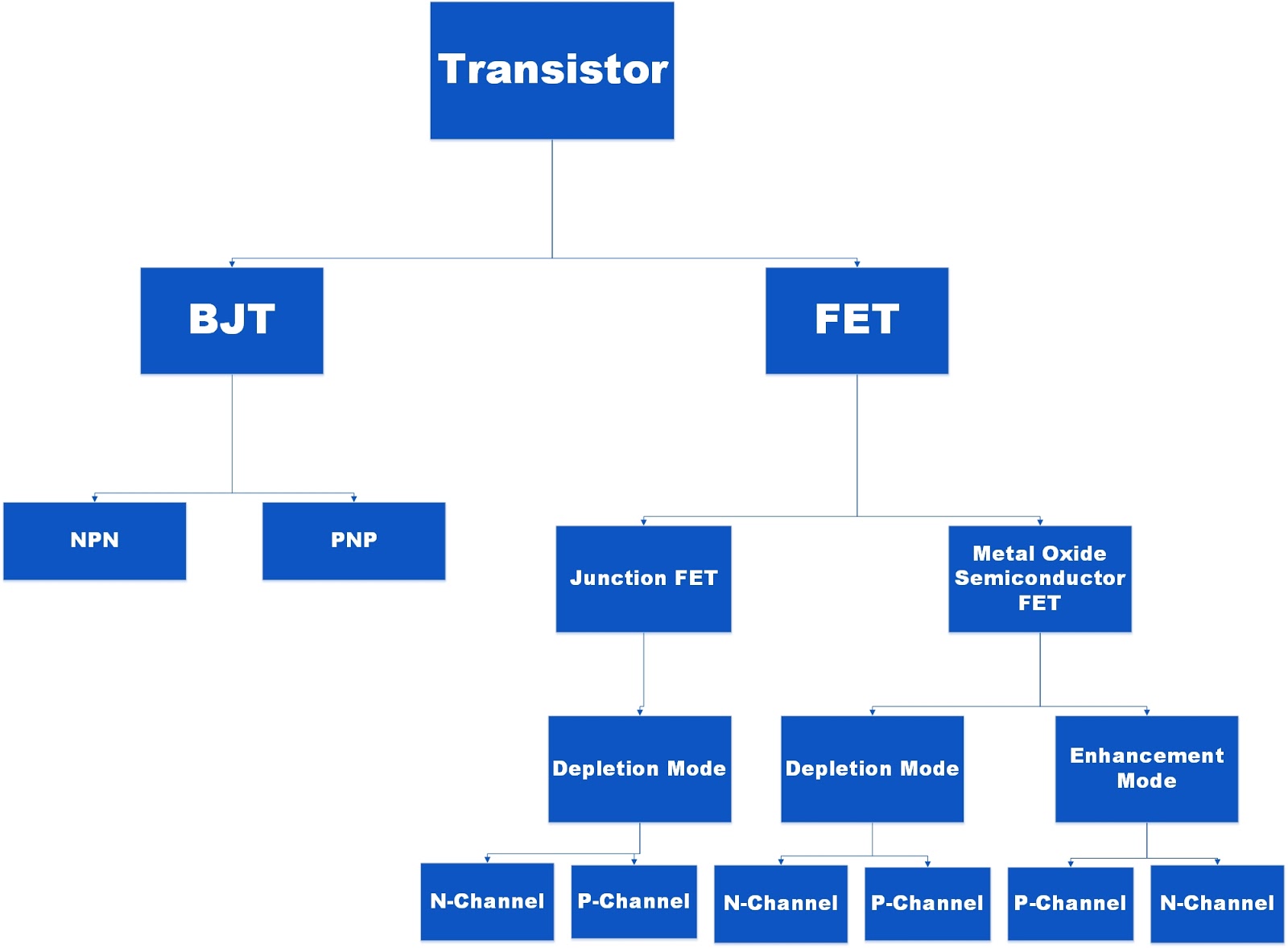
There two main types of Transistor,
  1. BJT Transistor (Bi Polar Junction)
  2. FETs Transistor(Field Effect Transistor)

BJT transistor are further classified to:
  1. n-p-n
  2. p-n-p

While FETs have also further classification.
The transistor tree below show classification of these Transistors.


Wednesday, 3 January 2018

Electric Potential: definition, explanation, example.

Definition:

"Electric potential is the amount of word done in moving a point test charge from its original position(reference position) to some specific point or position, while moving the charge in direction opposite to direction of field in which charge is present."


Explanation:-

The definition above seem to be difficult to understand the electric potential but I will explain it briefly.
Consider their is a positive point charge A, which have its own electric field around it. And there is another positive test charge B which has no electric field.


 When we will move the test charge B towards the electric field of point charge A then test charge B will move away from the point charge A. This is natural that charge always move from high potential to low potential.


low potential is the area where the charge feels less force while high potential is the area where the force is high.


So to move charge, against its natural movements. we have to provide electric potential or force or to do work. To move test charge B towards the charge A we have to apply some potential which is electric potential, to move the charge from low potential to high potential. So charge B will gain potential energy while moving towards high potential from low potential.

Electric potential is the basic studies of charges behavior with each other. So if you feel there is some type of confusion feel free to comment. The post will be update!

Saturday, 30 December 2017

Electric Charge density, definition, explanation

Definition:

"Electric charge density is the amount of charge on unit volume space or surface or area."


Explanation:

Electric charge density is the density of charge on unit area, the charge could be less or  more, and charge could be positive or negative.
as shown in figure 1 below, in which there is positive charge on surface but less and on figure 2, there is more positive charge.
So area in figure 2 have more electric charge density than figure 1.
The area or volume could be one dimensional, two dimensional and three dimensional. 


Formula:

The electric charge density can be written in the form,
Where p is the charge density and q is the amount of charge and v is the volume of space and unit area. we can replace the v by A, when there is unit area.

Electric flux density, definition, explanation

Definition:

"Electric flux density is the electric flux passing through some unit area, and its direction is perpendicular to that unit area."

Explanation:

"Electric flux density", when we break down this sentence into "electric flux" and "density".
Then it is easy to understand that, the density of electric flux across some area. Consider there is a unit area shown below.


Electric flux is passing through this, in direction perpendicular to the unit area. The amount of electric flux passing through this unit area, in direction perpendicular to the unit area is called Electric flux density.


Formula:

When we write mathematically the electric flux density it is equal to the product of electric field E and permittivity of material.

                                                                           D=Ɛ.E
Unit:
The unit of electric flux density is coulombs per meter squared. 

Tuesday, 28 November 2017

Electric Motor(AC)

Definition:-

"An electric device that converts an AC electric source into mechanical energy is known as AC electric motor"

The device that converts Electrical energy into mechanical energy for our use, we called that device electric motor.

Explanation:-

The above diagram is of ac motor that converts an ac source into mechanical energy. The problem we face in ac motor is that, ac current changes its direction after half cycle. So it is not possible for conducting coil to move in one direction for complete cycle of  ac current. To overcome this problem, we use split rings instead of commutator, so that we could reverse the direction of current. and coil could move in one direction.

Construction:-

It consists of,

1.Magnet
2.Conducting loop
3.Split rings
4.Carbon brushes
5.Ac source

Working:-

AC motor works on the same principle, as DC motor works. When we connect ac current source to the carbon brushes then through split rings current starts to flow through the wire( or conducting loop) so because there is also magnet field through wire and now current flowing through it, So according to Fleming's left hand rule, the coil will start to move. When ac current will change its direction split rings will change their direction and so coil will get same directed current and coil will move in one direction.

Electrical Motor(DC)

Definition:

"Electric motor is a device that converts electrical energy to mechanical energy"
The device which converts electrical energy into other form of energy which is mechanical energy so that we can take benefit from it.


Types of Motor:

There are two basic types of electric motor:-
1.DC motor
2.AC motor


DC motor Explanation:

The motor which converts DC power to the mechanical energy or power is known as dc motor.
Above diagram is of dc motor. It consists of a magnet, armature or conducting loops, carbon brushes, commutator, dc source or battery.

Working:-

When we connect the battery with the carbon brushes than through commutator they cause the current to flow through loops, as on the other hand there is also magnetic field from north to south so as we have studied Fleming's left hand rule(will explain below), the loops will move upward from one side and will move downward from other side. When this current carrying conductor(conducting loops) will change position at 90 degree than again according to the Fleming's rule this loop will move as it is going. So that how it works. other end of loop would be connected with the object to whom we want to provide mechanical energy. 

Fleming's Left hand rule:-

This rule states that" hold your left hand and tied your 1st finger, 2nd finger and thumb in such a way that they each other become perpendicular(Right angle) to each other. now if first finger is the direction of magnetic field and 2nd finger represent the current flowing through coil, then thumb will represent the force acting on it."