Showing posts with label current. Show all posts

Saturday, 15 June 2019

Transistor: Introduction, importance and history


Introduction:


The name “Transistor” has come from the two words “Transfer” and “Resistance”. Which then were combined into “Trans-resistance” and after that it was contracted to name as “Transistor”. From its origin words “transfer of resistance”, its process comes. Which is that the current passes from the low resistance portion to the high resistance portion for amplification.


Definition:  


“Transistor is a semiconductor device which is used to do the switching and amplifying of electronic signals.”

Means if you want to do switching in electric circuit like, to stop the flow of current at a point at particular condition then transistor is the best you got. Or if you want to amplify your input signal like if you want to increase the loudness of input voice then transistor can do this. These are the main uses of Transistor.


 History:


Before Transistor there was Vacuum tube which was the main or important component of electronic devices. But it was big in size have low efficiency, more heat up, high power consumption, required high voltages and current, and have complexity in circuits. Then there were ideas of Field effect transistor started to come in 1905. And then in 1947 John Bardeen and Walter Brattain and William Shockley (Group leader) invented the first complete transistor named as “point contact transistor”.  And then the first commercially available transistor came in 1960s.


Importance of Transistor:


Honestly! I will say in electric area the most useful thing we have now a days is transistor. Transistor is the building block of all the electric devices. We are getting now a days more smaller devices is just because of transistors as they have very small size. They are so small that we rarely found an individual transistor. They are found in integrated circuits in large numbers. An IC normally contain 20 to 60 transistors. The latest microprocessor contain almost 3 billion transistors and you can imagine the size of microprocessor. They are in our smart phones, smart watches, and radios and in every small smart device. The reason for their large use is their less cost and their requirements of low currents and voltages for operating.


Types of Transistor:

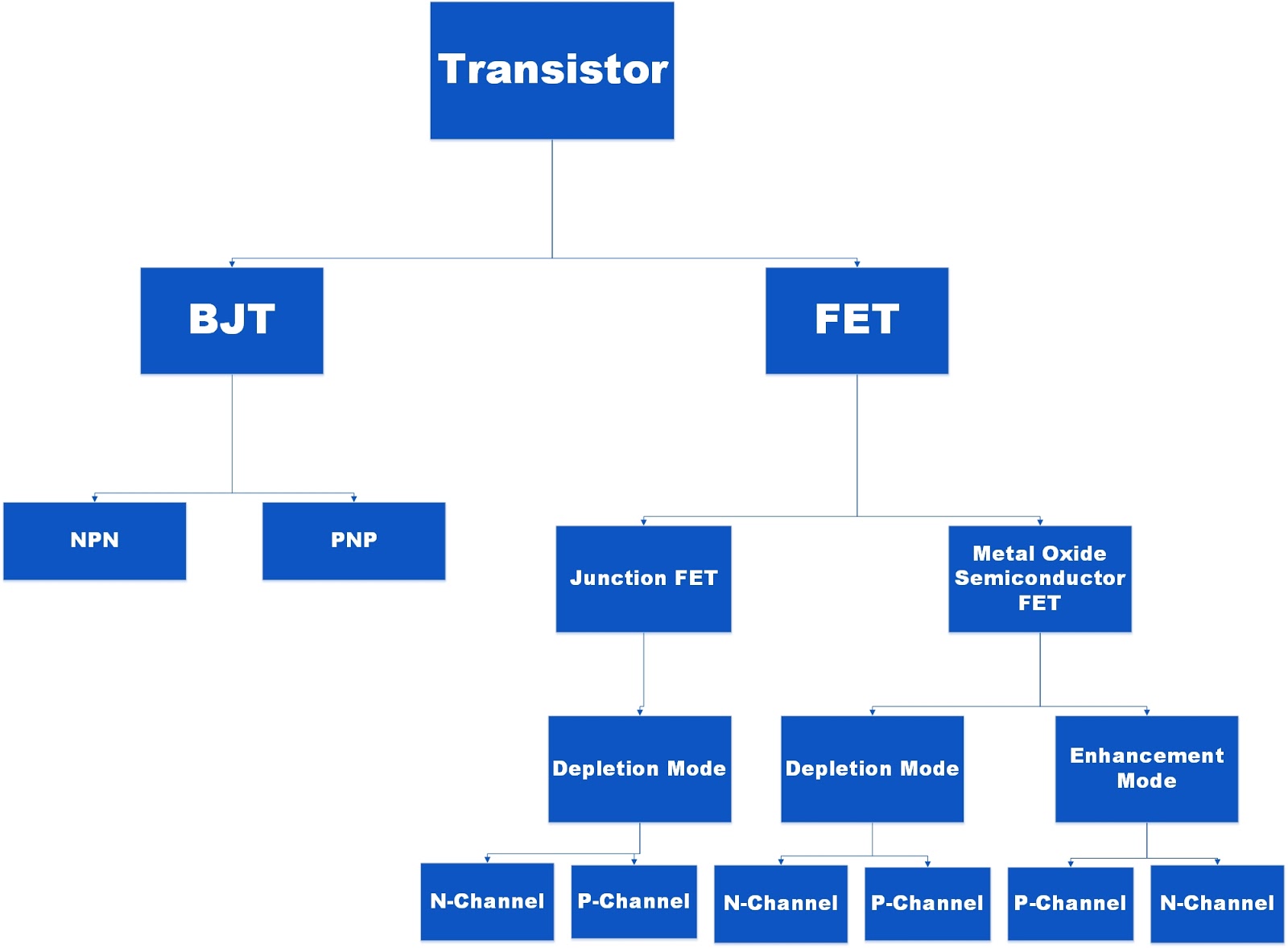
There two main types of Transistor,
  1. BJT Transistor (Bi Polar Junction)
  2. FETs Transistor(Field Effect Transistor)

BJT transistor are further classified to:
  1. n-p-n
  2. p-n-p

While FETs have also further classification.
The transistor tree below show classification of these Transistors.


Thursday, 4 January 2018

What is Charge, current, voltage? Definition explanation

Charge

Definition:

“Charge or Electrical charge is the property of, unit of a matter”

Explanation:

Charge does not physically exist; this is only a theoretical word. Yes, we use the word charge physically in many topics, just to describe the topic by taking a simple or basic thing (charge). Charge tells that how the matter will react with the other matter or in a magnetic field or in a electric field.
A matter is named as charge, only when there is a difference in number of electrons and number of protons in atom of that matter. If there are more electrons than proton in atom then it is negative charge and if there are more protons than electrons then it is positive charge. Hence this is two types of charge negative and positive charge.

Unit:-

The unit of charge is Coulomb and represented by q. 

Current

Definition:-

“Current is the rate of flow of electric charges.”

Explanation:-

Current is the flow of electric charges which is free electrons. Current flows in a circuit when there is pressure or some force applied to the charges in a circuit. Current flows from negative end to towards positive end. Rate of flow means, how much charges will flow in some fix time. There are two types of current. AC and DC.
AC means alternating current. The current which changes its direction of flow after half interval is known as alternating current.
DC means direct current. The current which flow in only one direction is known as DC current.
Each type of current has its own application.

Unit:-

Unit of current is A Ampere.
“When one coulomb charge will flow in one second through some point, then current will be one ampere.”

 Voltage

Definition:-

“Voltage is a force or pressure which causes the charges to flow through circuit.”

Explanation:

As we discuss in explanation section of current that , current flows through the circuit when some force or pressure applied to the charges in circuit. That force and pressure is Voltage. It is also known as potential difference. In some words, Voltage is the power of current. Means with how much power the current is flowing. The more the voltages the more the rate of flow of current in a circuit.

Unit:


Unit of voltage is V volt.

Friday, 1 December 2017

Transformer, Definition, Explanation, working, construction, types

Definition:-

"Transformer is an electrical device that converts low voltage into high voltage or high voltage into low voltage."


Explanation:-

Transform the current or voltage, it is used to get high voltage when input is of low voltage and to get low voltage from high voltage.

Transform works on the principal of Mutual Induction, according to which "When alternating current flows through one winding of coil, due changing nature of ac current, there produce an emf across winding and magnetic flux around winding. When another winding of coil comes near the first winding, there is effect of magnetic flux of first winding on second winding and due to AC current as it changes continuously produces changing magnetic flux of first winding and due to this change there causes the EMF in second winding and hence current starts to flow through second winding, so this process is known as mutual Inductance". Transformer works on this principle. As there is no connection between two coils(we just bring the second nearer to the first), the current transfer will be very small as compared to first. So we use Core to link these two winding, because of this current loss is so small.

Construction:-

 It consists of following,
1.Primary coil
2.Secondary coil
3.Core
4.AC current source

Working:-

Whenever we supplies ac current to primary coil then due to changing nature of ac current there produces change in magnetic flux around this winding. And due to this changing current starts to flow through core and reached to the secondary winding and through this secondary winding goes to external circuit, When we need to change low voltage to high voltage then we have to increase the winding of secondary coil. This type of transformer is known as Step up Transformer. If we want to change the high voltage into low voltage, than we have to decrease the winding of secondary coil. This type of transformer is known as Step down Transformer.