Showing posts with label types. Show all posts
Showing posts with label types. Show all posts
Saturday, 2 May 2020
Bipolar Junction Transistor(BJT) as a Amplifier
As we have discussed
the other uses of BJTs in previous posts, now there is another main use or
advantage of Bipolar transistor is that it can amplify the input signal
whether it is voltage or current. As some time we need to amplify the current
and sometimes voltage. We provide an input signal to the BJT, and it produces the
amplified signal at the output. The gain of the amplifier can be calculated by the
ratio of output to the input value of current or voltage. The amplifier does not change
the waveform or frequency. It just affects the current and voltage.
How to make BJT an
Amplifier:
To make BJT work as
amplifier we need to do some different types of configuration of it, in a
circuit. There are three configurations, which we can do,

Saturday, 15 June 2019
Transistor: Introduction, importance and history
Introduction:
The name “Transistor” has come from the two words “Transfer”
and “Resistance”. Which then were combined into “Trans-resistance” and after
that it was contracted to name as “Transistor”. From its origin words “transfer
of resistance”, its process comes. Which is that the current passes from the
low resistance portion to the high resistance portion for amplification.

Definition:
“Transistor is a semiconductor device which is used to do
the switching and amplifying of electronic signals.”
Means if you want to do switching in electric circuit like,
to stop the flow of current at a point at particular condition then transistor
is the best you got. Or if you want to amplify your input signal like if you
want to increase the loudness of input voice then transistor can do this. These
are the main uses of Transistor.
History:

Before Transistor there was Vacuum tube which was the main
or important component of electronic devices. But it was big in size have low
efficiency, more heat up, high power consumption, required high voltages and
current, and have complexity in circuits. Then there were ideas of Field effect
transistor started to come in 1905. And then in 1947 John Bardeen and Walter Brattain
and William Shockley (Group leader) invented the first complete transistor
named as “point contact transistor”. And
then the first commercially available transistor came in 1960s.

Importance of Transistor:
Honestly! I will say in electric area the most useful thing
we have now a days is transistor. Transistor is the building block of all the
electric devices. We are getting now a days more smaller devices is just
because of transistors as they have very small size. They are so small that we
rarely found an individual transistor. They are found in integrated circuits in
large numbers. An IC normally contain 20 to 60 transistors. The latest
microprocessor contain almost 3 billion transistors and you can imagine the
size of microprocessor. They are in our smart phones, smart watches, and radios
and in every small smart device. The reason for their large use is their less
cost and their requirements of low currents and voltages for operating.

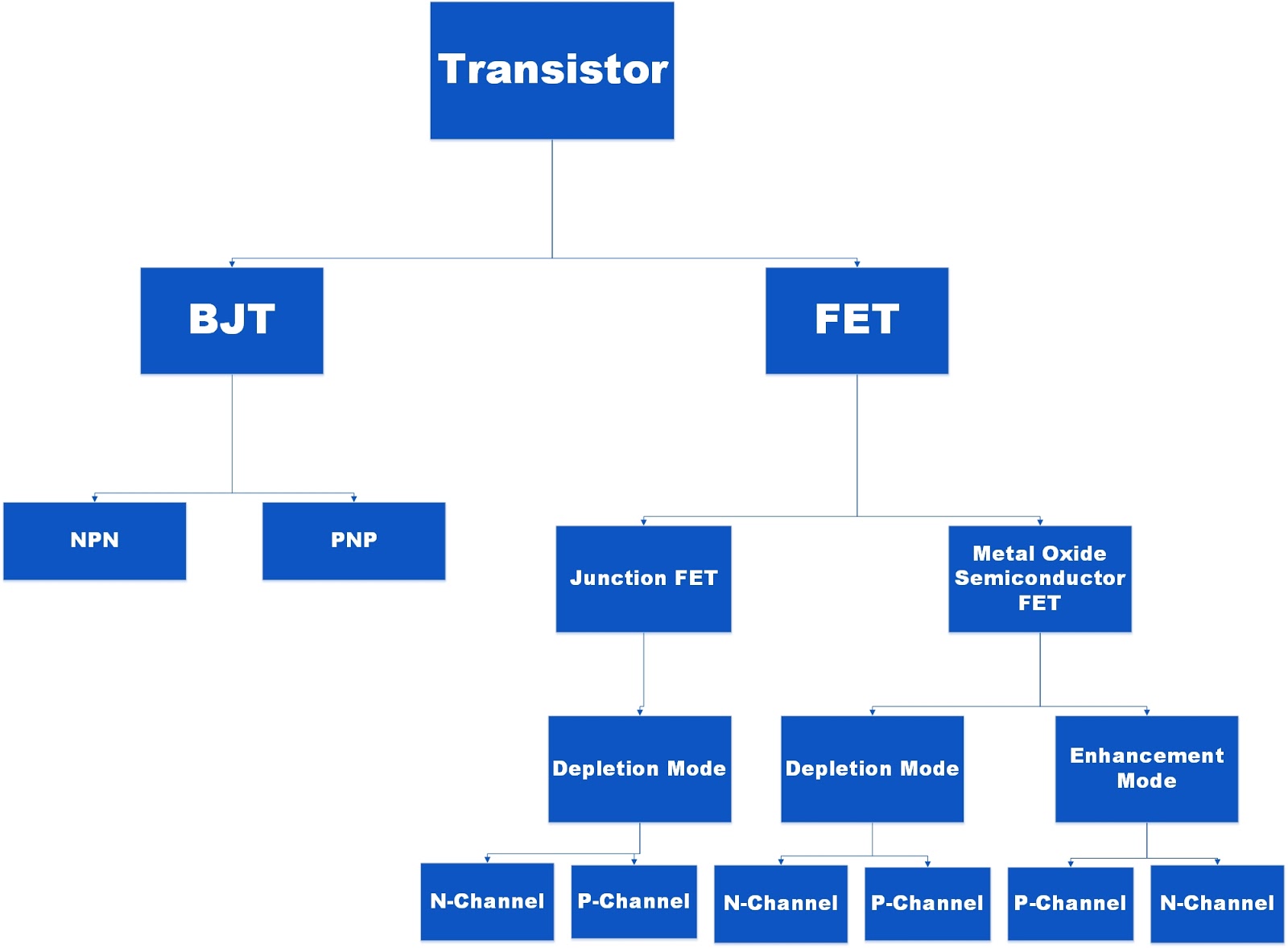
Types of Transistor:
There two main types of Transistor,
- BJT Transistor (Bi Polar Junction)
- FETs Transistor(Field Effect Transistor)
BJT transistor are further classified to:
- n-p-n
- p-n-p
While FETs have also further classification.
The transistor tree below show classification of these Transistors.
Friday, 1 December 2017
Waves and types of waves
Definition:-
"Wave is the transfer of energy from one place to another place without the transfer of matter or body."
Explanation:-
Wave only transfer energy or disturbance from one place to another place with transfer of matter, they travels through some medium.

The above shown diagram is of wave. As seen that there also some parts of waves. Crest and Trough.
The highest point of wave is known as crest and lowest part is known as tough, while rest position is the middle position.
Examples:-
1.When you throw the stone in the lake, then waves starts to travel arround the hit point of stone on water. these waves carries some energy, when you will put your finger in these waves you will some force.
2.Wind(Air flowing) is a kind of waves they can move away papers like stuff means carry some energy.
3. You speak, your voice travels to the other in the form of waves, as they feel sound means your voice has energy.
Types of Waves:-
there are three basics types of waves:-
1.Mechanical Waves act as the propagation of a disturbance through a material medium due to the repeated periodic motion of the particles of the medium about their mean positions, the disturbance being handed over from one particle to the next.
2.Electromagnetic Waves are the disturbance, which does not require any material medium for its propagation and can travel even through vacuum. They are caused due to varying electric and magnetic fields.
3.Matter Waves are the waves produced in electrons and particles
2.Electromagnetic Waves are the disturbance, which does not require any material medium for its propagation and can travel even through vacuum. They are caused due to varying electric and magnetic fields.
3.Matter Waves are the waves produced in electrons and particles
Transformer, Definition, Explanation, working, construction, types
Definition:-
"Transformer is an electrical device that converts low voltage into high voltage or high voltage into low voltage."

Explanation:-
Transform the current or voltage, it is used to get high voltage when input is of low voltage and to get low voltage from high voltage.

Transform works on the principal of Mutual Induction, according to which "When alternating current flows through one winding of coil, due changing nature of ac current, there produce an emf across winding and magnetic flux around winding. When another winding of coil comes near the first winding, there is effect of magnetic flux of first winding on second winding and due to AC current as it changes continuously produces changing magnetic flux of first winding and due to this change there causes the EMF in second winding and hence current starts to flow through second winding, so this process is known as mutual Inductance". Transformer works on this principle. As there is no connection between two coils(we just bring the second nearer to the first), the current transfer will be very small as compared to first. So we use Core to link these two winding, because of this current loss is so small.
Construction:-
It consists of following,
1.Primary coil
2.Secondary coil
3.Core
4.AC current source
Working:-
Whenever we supplies ac current to primary coil then due to changing nature of ac current there produces change in magnetic flux around this winding. And due to this changing current starts to flow through core and reached to the secondary winding and through this secondary winding goes to external circuit, When we need to change low voltage to high voltage then we have to increase the winding of secondary coil. This type of transformer is known as Step up Transformer. If we want to change the high voltage into low voltage, than we have to decrease the winding of secondary coil. This type of transformer is known as Step down Transformer.
Tuesday, 28 November 2017
Electric Motor(AC)
Definition:-
"An electric device that converts an AC electric source into mechanical energy is known as AC electric motor"
The device that converts Electrical energy into mechanical energy for our use, we called that device electric motor.

Explanation:-
The above diagram is of ac motor that converts an ac source into mechanical energy. The problem we face in ac motor is that, ac current changes its direction after half cycle. So it is not possible for conducting coil to move in one direction for complete cycle of ac current. To overcome this problem, we use split rings instead of commutator, so that we could reverse the direction of current. and coil could move in one direction.
Construction:-
It consists of,
1.Magnet
2.Conducting loop
3.Split rings
4.Carbon brushes
5.Ac source
Working:-
AC motor works on the same principle, as DC motor works. When we connect ac current source to the carbon brushes then through split rings current starts to flow through the wire( or conducting loop) so because there is also magnet field through wire and now current flowing through it, So according to Fleming's left hand rule, the coil will start to move. When ac current will change its direction split rings will change their direction and so coil will get same directed current and coil will move in one direction.
Electrical Motor(DC)
Definition:
"Electric motor is a device that converts electrical energy to mechanical energy"
The device which converts electrical energy into other form of energy which is mechanical energy so that we can take benefit from it.
The device which converts electrical energy into other form of energy which is mechanical energy so that we can take benefit from it.

Types of Motor:
There are two basic types of electric motor:-
1.DC motor
2.AC motor
DC motor Explanation:

The motor which converts DC power to the mechanical energy or power is known as dc motor.
Above diagram is of dc motor. It consists of a magnet, armature or conducting loops, carbon brushes, commutator, dc source or battery.
Working:-
When we connect the battery with the carbon brushes than through commutator they cause the current to flow through loops, as on the other hand there is also magnetic field from north to south so as we have studied Fleming's left hand rule(will explain below), the loops will move upward from one side and will move downward from other side. When this current carrying conductor(conducting loops) will change position at 90 degree than again according to the Fleming's rule this loop will move as it is going. So that how it works. other end of loop would be connected with the object to whom we want to provide mechanical energy.
Fleming's Left hand rule:-
This rule states that" hold your left hand and tied your 1st finger, 2nd finger and thumb in such a way that they each other become perpendicular(Right angle) to each other. now if first finger is the direction of magnetic field and 2nd finger represent the current flowing through coil, then thumb will represent the force acting on it."
Sunday, 26 November 2017
What is motion? Types of motion
Motion:-
When a body does not change its position with time it is said that it is in rest but when it changes it is called that body is in motion.
Types of Motion:-
There are few basic types of motion:
1. Translational motion
2. Rotational motion
3. Random motion
4. Circular motion
Translational:-
A body covering some distance while moving whether it is on straight line or curved line, but distance covering is necessary. it is known as translational motion.
i.e. You driving a car towards your destination the road sometimes will not be straight turns will come but you will cover distance.

Rotational:-
A body moving on its axis and its all parts have different directions. no matter in which direction it moves but move on its axis is known as rotational motion.
i.e. A beblayde moving on its axis, a fan blades moving.

Random Motion:
When a body moves randomly, it is known as random motion.
Random motion means when body doesn't follow a specific path just a zig zag type path to move then this movement is known as random motion.
When a body moves randomly, it is known as random motion.
Random motion means when body doesn't follow a specific path just a zig zag type path to move then this movement is known as random motion.
i.e. Fly, Mosquitoes etc, flying around you randomly is an example of random motion.


Circular Motion:
When a body moves in a circular path, it is known as circular motion.
it is simple type of motion when body moves in a closed circular path it is known as circular motion.
i.e. a racing car moving on a circular racing track.

Subscribe to:
Posts (Atom)